
Crude and Refined Products Price Review and Outlook
Crude oil prices on the global market rose to an average of about US$124/bbl in the pricing window under review, following the resurgence and escalation of hostilities between the US and Iran.
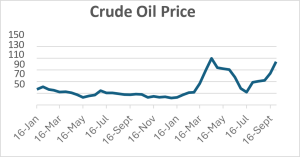
The conflict triggered a significant surge in international crude prices, which peaked at about US$130/bbl in April as hostilities intensified. However, following the commencement of negotiations in June between the two countries, prices subsequently declined on renewed expectations of de-escalation, improved global stability and the restoration of normal flows through the Strait of Hormuz. The Strait is a critical global oil channel, with about 20% of global petroleum liquids consumption transiting through it.

Following the ceasefire, crude oil prices declined from their peak to an average of about US$70/bbl in July. However, stalled negotiations and renewed hostilities have once again heightened geopolitical tensions in the Middle East, pushing crude prices back above US$120/bbl. From January to date, crude prices have increased by 101.16%.
The surge in crude prices has also translated into higher refined petroleum product prices. Petrol, diesel, LPG and ATK increased on the international market by 2.43%, 6.91%, 8.55% and 9.86%, respectively. Diesel has increased by more than 140.11% since January and about 113.05% year-on-year, while petrol is up 74.15% year-on-year and 110.71% since January.
The impact is increasingly evident in major markets. According to Reuters News agency, US diesel prices have risen above US$6.50/gallon, reaching record levels, while the US administration has considered measures to increase domestic diesel availability, including voluntary export restrictions. However, the White House has clarified that no blanket diesel export ban is currently being pursued. In Ghana, the continued rise in international crude and refined-product prices, is expected to exert upward pressure on domestic petroleum prices during the 1st to 15th October 2026 pricing window.
FuFeX30 and Spot Rates
The Fufex30 1 for the first selling window of October (1st to 15th October 2026) is estimated at GHS11.9000/USD, based on quotations received from oil-financing commercial banks. Moreover, the applicable spot rate for cash sales is estimated at GHS11.7500/USD. The depreciation of the cedi is expected to further amplify the impact of rising refined petroleum product prices on domestic consumers. Efforts to maintain FX stability could therefore cushion consumers from further increases.

The Ex-Refinery Price Indicator (Xpi)
The Ex-ref price indicator (Xpi) is computed using the referenced international market prices usually adopted by BIDECs, factoring in the CBOD economic breakeven benchmark premium for a given window and converting from USD/mt to GHS/ltr using the Fufex30 for sales on credit and the spot FX rate for sales on cash.
Ex-ref Price Effective 1st to 15th October 2026
| Price Component | Petrol | Diesel | LPG |
| Average World Market Price (US$/mt) | 1306.3800 | 1516.0500 | 778.9800 |
| CBOD Benchmark Breakeven Premium
(US$/mt) |
150 | 250 | 300 |
| Spot FX Rates | 11.7500 | 11.7500 | 11.7500 |
| FuFex30 (GHS/USD) | 11.9000 | 11.9000 | 11.9000 |
| Volume Conversion Factor (ltr/mt) | 1324.50 | 1183.43 | 1000.00 |
| Ex-ref Price (GHS/ltr) Cash Sales | 12.9199/ltr | 17.5347/ltr | 12.6780/kg |
| Ex-ref Price (GHS/ltr) 45-day Credit Sales | 13.0849/ltr | 17.7585/ltr | 12.8399/kg |
| Price Tolerance | +1%/-1% | +1%/-1% | +1%/-1% |
Taxes, Levies, and Regulatory Margins
During the 16th to 3oth September 2026 pricing window, taxes, levies and regulatory margins accounted for about 25.26%, 12.37% and 12.78% of the ex-pump prices of petrol, diesel and LPG, respectively. However, following the recent surge in international petroleum product prices, particularly diesel, the Government suspended selected levies and margins equivalent to GH¢2.00 per litre on diesel to mitigate the impact on consumers.
| TRM Components | Petrol (GHS/ltr) | Diesel (GHS/ltr) | LPG (GHS/KG) |
| ENERGY SECTOR SHORTFALL AND DEBT
REPAYMENT LEVY |
1.95 | 1.93 | 0.73 |
| ROAD FUND LEVY | 0.48 | 0.48 | – |
| ENERGY FUND LEVY | 0.01 | 0.01 | – |
| PRIMARY DISTRIBUTION MARGIN | 0.26 | 0.0 | – |
| BOST MARGIN | 0.12 | 0.0 | – |
| FUEL MARKING MARGIN | 0.09 | 0.0 | – |
| SPECIAL PETROLEUM TAX | 0.46 | 0.46 | 0.48 |
| UPPF | 0.90 | -0.63 | 0.85 |
| DISTRIBUTION/PROMOTION MARGIN | – | – | 0.05 |
| TOTAL | 4.27 | 2.25 | 2.1 |
OMC Pricing Performance: 16th to 30th September 2026
Ex-pump prices of petroleum products have surged significantly across several markets globally, largely reflecting the impact of the US-Iran conflict, which escalated significantly from March 2026. In the US, diesel prices have increased sharply, reaching about US$6.52 per gallon, representing an increase of about 73% since the conflict began, while gasoline prices have also risen amid supply disruptions and higher global crude prices.
Similarly, in Ghana, pump prices have risen substantially since the conflict began, compelling Government to intervene to cushion consumers as commercial transport operators threatened significant fare increases. Pump prices of petrol and diesel increased from average levels of GH¢11.1210/Ltr and GH¢12.3960/Ltr in February, before the conflict intensified, to GH¢16.9056/Ltr and GH¢18.1856/Ltr, respectively, in the last pricing window of September. Government initially intervened by suspending selected levies and margins on petrol and diesel for two months, which were subsequently reinstated following the ceasefire and easing of international petroleum prices. However, the renewed escalation in hostilities and resulting increase in international prices prompted Government to again suspend about GH¢2/Ltr of levies and margins on diesel to cushion consumers. The intervention was particularly targeted at diesel, given its significant price increase and importance to commercial transport and economic activity.

From the beginning of the conflict to date, pump prices of petrol, diesel and LPG have increased by about 52.02%, 46.69% and 28.71%, respectively, despite the Government’s GH¢2/Ltr diesel intervention. The Ghana Private Road Transport Union (GPRTU) subsequently agreed to an 8% increase in public transport fares effective 26 September 2026, following consultations with Government. Although GPRTU initailly proposed a higher rate, the final adjustment was reduced due the GH¢2/Ltr inteverntion by government.

The average pump price of petrol across all retail outlets increased by 7.55%, from GH¢15.6711/Ltr to GH¢16.9056/Ltr, driven largely by the surge in international petroleum product prices. The increase pushed the average petrol pump price above the GH¢16/Ltr mark for the first time since November 2022, highlighting the significant upward pressure on domestic fuel prices arising from developments in the international market.

The average pump price of diesel increased by 5.36%, crossing the GH¢18/Ltr mark for the first time since November 2022, when pump prices exceeded GH¢20/Ltr. This suggests that the Government’s suspension of selected taxes, levies and margins on diesel has helped moderate the extent of the increase in domestic diesel prices, despite the significant rise in international petroleum product prices.
However, during the 1st to 15th October 2026 pricing window, pump prices are projected to increase across OMCs, reflecting the continued rise in crude and petroleum product prices amid stalled negotiations between the US and Iran. Nevertheless, an improvement in petroleum supply and easing of supply constraints in the Middle East, particularly Saudi Arabia, could ease international prices and, consequently, limit the extent of increases in pump prices.
[1] The Fufex30 is a 30-day GHS/USD forward FX rate used as a benchmark rate by BIDECs ex-ref price estimations.